Cases of broader legal significance
Thomas Spaas acts in matters where fundamental principles of tax law, fundamental rights or the democratic rule of law are at stake.
Alongside his advisory work, Thomas Spaas handles matters that go beyond the individual interest of a client. These are cases that sharpen legal principles: where the limits of governmental discretion lie, what the scope of tax regulation is, and what protection fundamental rights offer in concrete disputes.
Thomas Spaas always seeks an amicable, practical solution in such cases first. Where that avenue is closed, he acts before the courts - with doctrinal precision and procedural consistency, including before the Court of Justice of the European Union.
Legal innovation
Thomas Spaas is regularly confronted with questions for which the law does not yet provide a settled framework: new technology, new forms of wealth or new societal issues. In such matters he builds the legal argument where precedents are largely absent, and translates complex technical or factual material into a substantiated legal claim.
Where possible he masters the underlying subject matter himself - from the workings of a technology to the empirical basis of a societal problem - rather than outsourcing that analysis entirely. On that basis he designs the legal framework the matter requires.
The same approach underlies the "Cultuurdefensie" case (defence of culture), in which Thomas Spaas acts as counsel for the Stichting Democratische Vernieuwing (Foundation for Democratic Renewal) - a matter of principle concerning the limits of governmental discretion and fundamental democratic principles, to be heard before Belgian and European courts.
In the press
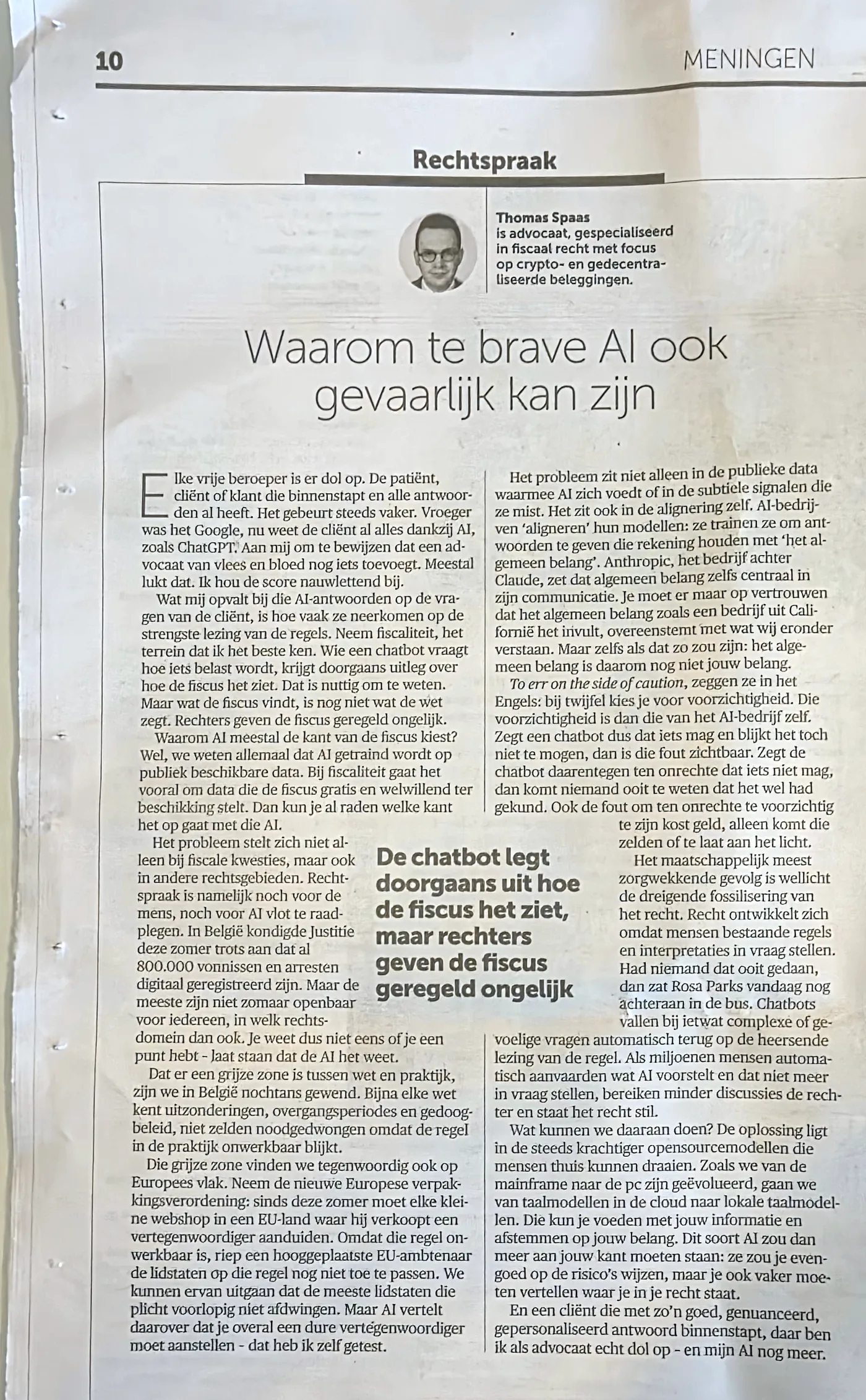
Clients increasingly arrive with an answer from an AI chatbot, and that answer often amounts to the strictest reading of the rules: in tax matters, usually the position of the tax authorities, even though the courts regularly rule against them.
Thomas Spaas points to two causes. AI learns from what is publicly available, which means plenty of administrative guidance and little case law (in Belgium only a fraction of judgments is published online); in addition, AI companies deliberately tune their models towards caution and the 'general interest'.
Those who no longer question these answers bring fewer disputes before the courts, and without new case law the law stops evolving.
His proposal: personal AI assistants that serve the interests of their user and also tell them where the law is on their side.
Also in the press
De Standaard, 30 October 2026
Na de grootste cryptoroof ooit: hoe veilig zijn bitcoin en co. nog? (After the biggest crypto heist ever: how safe are bitcoin and co.?)
Thomas Spaas was interviewed by De Standaard about the hack of the Binance exchange, in which 6.3 billion dollars in crypto was stolen, and about how safe bitcoin and other cryptocurrencies still are.
“Bitcoin, on the other hand, cannot be frozen. That it lies beyond anyone’s control is precisely its greatest strength.” (translated from Dutch)